Showing posts with label jazz. Show all posts

Saturday, February 26, 2011

LOUIS ARMSTRONG IN JAZZ REVIEW BY GEORGE PATTERSON FROM THE ROARING FORTIES JUMP JIVE SWING BAND


The Personification Of Jazz

Louis Satchmo Armstrong

Artist Biography by: Lee Prosser


The auditorium was packed...standing room only. The people were ready. There was an aura of splendor hovering over the audience excitement, allied with love as they waited to hear the inimitable, and, paramount musician, singer, and entertainer the world over..."Louis "Satchmo" Armstrong"
When the band kicked off the intro to "Hello Dolly," the audience went into an emotion-packed uproar as they watched their hero, with his unmistakable prance, walk to the microphone, his trumpet in one hand, his handkerchief in the other...his smile was so big, it could light up Broadway. Louie gave them want they wanted it went something like this..."Hello...Dolly...oh...Hello...Dolly..." Hearing this, the audience clapped and yelled so much, it made you think a cataclysmic eruption was eminent! His fans loved him so much, as did the rest of the world; they showed it with their hands and emotional outburst of respect and adoration for a man who stands for so much primarily, love!

On February 15, 1964, Louis recorded "Hello Dolly" it became an instant hit across the nation, while pushing the Beatles down a few notches. The incredible success of "Hello Dolly" was a remarkable triumph for a man who had revolutionized American music nearly forty years earlier. On July 6, 1971, Louis took his leave; the composite memory of him, the music of America coming from his horn, his total persona-on and off the stage, his humor, his love, which he gave to the world, all of which will linger on as long as there are ways and means to hear and see Louie, we will always have access to the most incredible musician and singer in the history of music............... "The Patron Saint of The Entertainment World."

Louie always thought of himself as, and insisted that he was, a child of the American century; born July 4th, 1900. However, the truth holds that, he was born on August 4th, 1901, which is documented in the Baptismal Registry of the Sacred Heart of Jesus Church in New Orleans. The actual date is not as important; but what is important is, what Louis gave to the world...he gave of himself!

Louis grew up in the ghetto of New Orleans; in the area known as Storyville; the boarding houses and the red light district. On one 4th of July, fireworks were going off everywhere. Now Louie, without any fireworks, borrowed a pistol and began shooting some rounds into the air; subsequently, he was abducted by the local authorities and put in the Colored Waif Home, which was founded by Captain Joseph Jones.

From the video documentary, "Satchmo," Edward R. Murrow asked Louie, "What was it like in the Waif Home?" Louie had this to say..."There was a music teacher name Mr. Peter Davis. He didn't notice me at first, he thought I was one of da bad boys from the street. Then one day, he asked me to be the bugler...this was good, I could play the blues. When I got out, I went right to see King Oliver. I know his wife, Mrs. Oliver, she always give me dem red beans and rice. What I want more than anything is lessons. Oliver gave me lessons-I was ready."

Louis was a quick learner. In 1918, King Oliver and his band went to the Lincoln Gardens in Chicago. Louis was asked to take Oliver's place with the hottest band in New Orleans, "Kid Ory and His Creole Jazz Orchestra." Then in 1922, Louis joined up with the "Tuxedo Jazz Band." It was this year that King Oliver called for Louie to come to Chicago and play second trumpet at the Lincoln Gardens. In the same interview with Murrow, he asked Louie..."Did that make you happy?" Louie's smile got bigger …"OH - Yeah...could nobody get me out of New Orleans."

King Oliver played with the same style as Louie, but with a softer tone. Louis had some powerful shops, and because of that, in a recording session, Louis was asked to stand some distance behind so as not to overpower the band. Louie played second harmony to King's lead. Louie had an uncanny talent to anticipate a phrase King might play...without music, Louie was in there with the right harmony note. King Oliver was Louie's mentor, he served as a father image for Louie. After two years in Chicago, King Oliver and Louie made musical history. It was here in the Windy City that Louis recorded his solo effort, "Chimes Blues."

Were it not for Olivers' pianist, Lillian Hardin, the trumpet duet might have continued. She took a special interest in Louie and became the second major influence in his life. In 1924, Louie and Lillian were married. Louis was called by the great bandleader and arranger, Fletcher Henderson, to come to NewYork and play in his orchestra. It was his wife who encouraged Louis to go that same year.

So in September 1924, Louie set out to join the Henderson musical conglomerate. He brought with him, a quality of solo playing far exceeding anything that New York had heard thus far in jazz. Louie's musical ideas and the harmony knowledge he learned with Oliver, were a stimulus to action for Henderson's staff arranger, Don Redman. Louie remained with Henderson for about a year.
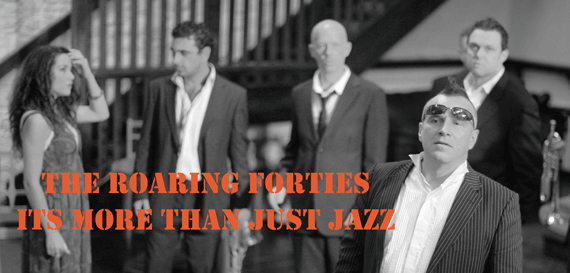
If you love Jazz you will love The Roaring Forties www.theroaringforties.com

SWING MUSIC AND DANCE By George Patterson of THE ROARING FORTIES

History of Swing Dancing

The history of swing dates back to the 1920's, where the black community, while dancing to contemporary Jazz music, discovered the Charleston and the Lindy Hop.

On March 26, 1926, the Savoy Ballroom opened its doors in New York. The Savoy was an immediate success with its block-long dance floor and a raised double bandstand. Nightly dancing attracted most of the best dancers in the New York area. Stimulated by the presence of great dancers and the best black bands, music at the Savoy was largely Swinging Jazz. One evening in 1927, following Lindbergh's flight to Paris, a local dance enthusiast named "Shorty George" Snowden was watching some of the dancing couples. A newspaper reporter asked him what dance they were doing, and it just so happened that there was a newspaper with an article about Lindbergh's flight sitting on the bench next to them. The title of the article read, "Lindy Hops The Atlantic," and George just sort of read that and said, "Lindy Hop" and the name stuck.

In the mid 1930's, a bouncy six beat variant was named the Jitterbug by the band leader Cab Calloway when he introduced a tune in 1934 entitled "Jitterbug".

With the discovery of the Lindy Hop and the Jitterbug, the communities began dancing to the contemporary Jazz and Swing music as it was evolving at the time, with Benny Goodman leading the action. Dancers soon incorporated tap and jazz steps into their dancing.

In the mid 1930's, Herbert White, head bouncer in the New York City Savoy Ballroom, formed a Lindy Hop dance troupe called Whitey's Lindy Hoppers. One of the most important members of Whitey's Lindy Hoppers was Frankie Manning. The "Hoppers" were showcased in the following films: "A Day at the Races" (1937), "Hellzapoppin" (1941), "Sugar Hill Masquerade" (1942), and "Killer Diller" (1948).

In 1938, the Harvest Moon Ball included Lindy Hop and Jitterbug competition for the first time. It was captured on film and presented for everyone to see in the Paramount, Pathe, and Universal movie newsreels between 1938 and 1951.

In early 1938, Dean Collins arrived in Hollywood. He learned to dance the Lindy Hop, Jitterbug, Lindy and Swing in New York City and spent a lot of time in Harlem and the Savoy Ballroom. Between 1941 and 1960, Collins danced in, or helped choreograph over 100 movies which provided at least a 30 second clip of some of the best California white dancers performing Lindy Hop, Jitterbug, Lindy and Swing.

In the late 1930's and through the 1940's, the terms Lindy Hop, Jitterbug, Lindy, and Swing were used interchangeably by the news media to describe the same style of dancing taking place on the streets, in the night clubs, in contests, and in the movies.

By the end of 1936, the Lindy was sweeping the United States. As might be expected, the first reaction of most dancing teachers to the Lindy was a chilly negative. In 1936 Philip Nutl, president of the American Society of Teachers of Dancing, expressed the opinion that swing would not last beyond the winter. In 1938 Donald Grant, president of the Dance Teachers' Business Association, said that swing music "is a degenerated form of jazz, whose devotees are the unfortunate victims of economic instability." In 1942 members of the New York Society of Teachers of Dancing were told that the jitterbug (a direct descendent of the Lindy Hop), could no longer be ignored. Its "cavortings" could be refined to suit a crowded dance floor.

The dance schools such as The New York Society of Teachers and Arthur Murray, did not formally begin documenting or teaching the Lindy Hop, Jitterbug, Lindy, and Swing until the early 1940's. The ballroom dance community was more interested in teaching the foreign dances such as the Argentine Tango, Spanish Paso Doblé, Brazilian Samba, Puerto Rican Merengue, Cuban Mambo and Cha Cha, English Quickstep, Austrian Waltz, with an occasional American Fox-trot and Peabody.

In the early 1940's the Arthur Murray studios looked at what was being done on the dance floors in each city and directed their teachers to teach what was being danced in their respective cities. As a result, the Arthur Murray Studios taught different styles of undocumented Swing in each city.

In the early 1940's, Lauré Haile, as a swing dancer and competitor, documented what she saw being danced by the white community. At that time, Dean Collins was leading the action with Lenny Smith and Lou Southern in the night clubs and competitions in Southern California. Lauré Haile gave it the name of "Western Swing". She began teaching for Arthur Murray in 1945. Dean Collins taught Arthur Murray teachers in Hollywood and San Francisco in the late 1940's and early 1950's.

After the late 1940's, the soldiers and sailors returned from overseas and continued to dance in and around their military bases. Jitterbug was danced to Country-Western music in Country-Western bars, and popularized in the 1980's.

As the music changed between the 1920's and 1990's, (Jazz, Swing, Bop, Rock 'n' Roll, Rhythm & Blues, Disco, Country), the Lindy Hop, Jitterbug, Lindy, and Swing evolved across the U.S. with many regional styles. The late 1940's brought forth many dances that evolved from Rhythm & Blues music: the Houston Push and Dallas whip (Texas), the Imperial Swing (St. Louis), the D.C. Hand Dancing (Washington), and the Carolina Shag (Carolinas and Norfolk) were just a few.

In 1951 Lauré Haile first published her dance notes as a syllabus, which included Western Swing for the Santa Monica Arthur Murray Dance Studio. In the 50's she presented her syllabus in workshops across the U.S. for the Arthur Murray Studios. The original Lauré Haile Arthur Murray Western Swing Syllabus has been taught by Arthur Murray studios with only minor revisions for the past 44 years.

From the mid 1940's to today, the Lindy Hop, Jitterbug, Lindy, and Swing, were stripped down and distilled by the ballroom dance studio teachers in order to adapt what they were teaching to the less nimble-footed general public who paid for dance lessons. As a result, the ballroom dance studios bred and developed a ballroom East Coast Swing and ballroom West Coast Swing.

In the late 1950's, television brought "American Bandstand", "The Buddy Dean Show" and other programs to the teenage audiences. The teenagers were rocking with Elvis Presley, Little Richard, and Chuck Berry leading the fray. In 1959, some of the California dance organizations, with Skippy Blair setting the pace, changed the name of Western Swing to West Coast Swing so it would not be confused with country and western dancing.

In the 1990's, dancers over 60 years of age still moving their Lindy Hoppin', Jitterbuggin', Swingin', and Shaggin' feet.

SWING STYLES

Savoy Swing: a style of Swing popular in the New York Savoy Ballroom in the 30's and 40's originally danced to Swing music. The Savoy style of swing is a very fast, jumpy, casual-looking style of dancing

Lindy style is a smoother-looking dance.

West Coast Swing: a style of Swing emphasizing nimble feet popular in California night clubs in the 30's and 40's and voted the California State Dance in 1989.

Whip: a style of Swing popular in Houston, Texas, emphasizing moves spinning the follower between dance positions with a wave rhythm break.

Push: a style of swing popular in Dallas, Texas, emphasizing moves spinning the follower between dance positions with a rock rhythm break.

Supreme Swing: a style of Swing popular in Tulsa, Oklahoma.

Imperial Swing: a style of Swing popular in St. Louis, Missouri.

Carolina Shag: a style of Swing popular in the Carolinas emphasizing the leader's nimble feet.

DC Hand Dancing: a Washington, DC synthesis of Lindy and Swing.

East Coast Swing: a 6 count style of Lindy popular in the ballroom dance school organizations.

Ballroom West Coast Swing: a style of swing popular in the ballroom dance school organizations and different from the style performed in the California night clubs and Swing dance clubs.

Country-Western Swing: a style of Jitterbug popularized during the 1980's and danced to Country and Western music.

Cajun Swing: a Louisiana Bayou style of Lindy danced to Cajun music.

Pony Swing: a Country Western style of Cajun Swing.

Jive: the International Style version of the dance is called Jive, and it is danced competitively in the US and all over the world.